Cybersecurity is the practice of protecting computer systems, networks, devices, and data from unauthorized access, cyberattacks, and damage. In an era where nearly every business operation depends on digital infrastructure, understanding what cybersecurity is — and how it works — has become essential for organizations of all sizes.
According to IBM’s 2024 Cost of a Data Breach Report, the global average cost of a data breach reached $4.88 million — the highest figure ever recorded. For startups and SMEs without a dedicated security team, a single incident can be catastrophic. That is why cybersecurity is no longer optional: it is a business-critical function.
What Does Cybersecurity Mean?
At its core, cybersecurity refers to the set of technologies, processes, and practices designed to protect digital systems from attacks, unauthorized access, and data breaches. The term covers a wide spectrum — from securing a single device to defending the entire IT infrastructure of a multinational corporation.
Cybersecurity operates across three main objectives, known as the CIA Triad:
- Confidentiality — ensuring that sensitive data is only accessible to authorized users.
- Integrity — protecting data from being tampered with or altered without authorization.
- Availability — ensuring that systems and data are accessible to legitimate users when needed.
Types of Cybersecurity
Cybersecurity is not a single discipline — it encompasses multiple specialized domains, each addressing a different layer of risk:
Network Security
Network security protects the infrastructure that connects your systems — routers, firewalls, VPNs, and access controls — from intrusion and misuse. It is the first line of defense against external attackers attempting to access your internal systems.
Endpoint Security
Every device that connects to your network is a potential entry point for attackers. Endpoint security covers laptops, mobile phones, servers, and increasingly, IoT devices — ensuring each one is protected, monitored, and up to date.
Application Security
Application security focuses on identifying and fixing vulnerabilities within software before attackers can exploit them. This includes web and API penetration testing, secure code reviews, and following frameworks like the OWASP Top 10.
Cloud Security
As organizations move workloads to the cloud, securing those environments becomes critical. Cloud security covers identity management, data encryption, misconfiguration detection, and compliance monitoring across platforms like AWS, Azure, and Google Cloud.
IoT Security
The Internet of Things has dramatically expanded the attack surface. Connected sensors, industrial controllers, and smart devices often lack basic security controls — making IoT security assessments a critical priority for any organization that uses connected hardware.
Operational Security (OpSec)
Operational security addresses the processes and decisions around handling and protecting sensitive data. It covers policies on who can access what information, how data is stored and shared, and how incidents are detected and responded to.
The Most Common Cybersecurity Threats in 2026
Understanding the threat landscape is the first step toward building an effective defense. These are the attacks organizations face most frequently today:
Phishing and Social Engineering
Phishing remains the most common attack vector globally. Attackers send deceptive emails, messages, or fake websites that trick users into revealing credentials or downloading malware. According to Verizon’s 2024 DBIR, 68% of breaches involved a human element — making employee awareness training as important as any technical control.
Ransomware
Ransomware encrypts an organization’s files and demands payment for the decryption key. Attacks have surged against SMEs, hospitals, and critical infrastructure. In 2024, the average ransomware payment exceeded $2 million — but for small businesses, a ransomware attack often means complete operational shutdown with no IT team available to respond.
Supply Chain Attacks
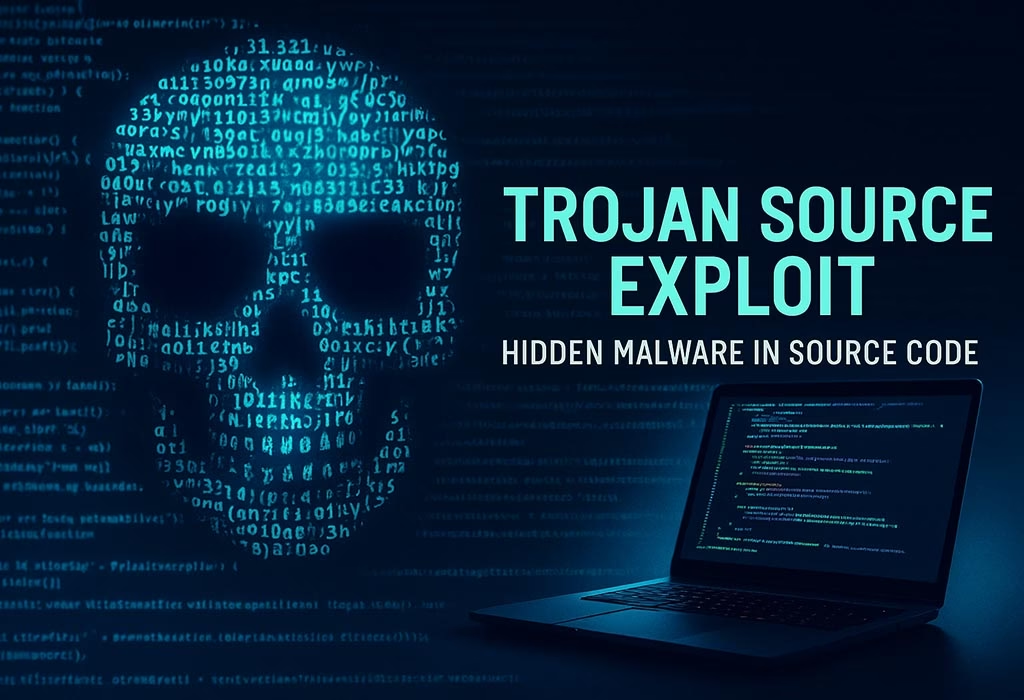
Rather than attacking a target directly, adversaries compromise a trusted software vendor or supplier and use that access as a backdoor. The SolarWinds attack (2020) and the XZ Utils backdoor (2024) are landmark examples of how devastating supply chain compromise can be at global scale.
AI-Powered Attacks
Generative AI is now being weaponized to craft highly convincing phishing emails, generate malware variants, and automate reconnaissance at scale. This raises the baseline sophistication of threats that even small organizations must now defend against.
Why Cybersecurity Matters for SMEs and Startups
A common misconception is that cybercriminals only target large enterprises. In reality, small and medium businesses account for 43% of all cyberattack targets (Verizon DBIR, 2024), largely because they hold valuable data but typically have weaker defenses than large corporations.
For startups handling customer data, financial transactions, or proprietary technology, a single breach can mean regulatory fines under GDPR, loss of customer trust, operational downtime, and in some cases, the end of the business entirely.
Effective cybersecurity does not require an enterprise budget. A Virtual CISO (vCISO) provides senior security leadership and a tailored security program at a fraction of the cost of a full-time hire — making it the preferred model for lean, fast-growing companies across Europe.
Cybersecurity Best Practices for 2026
Building a resilient cybersecurity posture starts with fundamentals. These are the highest-impact controls any organization can implement regardless of size or budget:
- Enable Multi-Factor Authentication (MFA) on all critical accounts, including email, cloud platforms, and admin panels.
- Keep software and systems patched. Unpatched vulnerabilities are the most exploited attack vector in the wild.
- Apply the principle of least privilege — users and systems should only have access to what they strictly need.
- Conduct regular security assessments, including penetration testing, to find and fix vulnerabilities before attackers do.
- Train your team. Security awareness training significantly reduces the risk of phishing and social engineering attacks.
- Have an incident response plan. Knowing what to do in the first hours of a breach dramatically limits its impact and cost.
- Back up your data regularly and test the recovery process — your last line of defense against ransomware.
How MicroHackers Can Help You Stay Secure
At MicroHackers, we provide cybersecurity services purpose-built for startups, SMEs, and industrial companies across Europe and LATAM. Our certified security professionals help you identify vulnerabilities, achieve compliance with ISO 27001, NIS2, and GDPR, and build security programs that hold up under real-world pressure.
Whether you need a Virtual CISO to lead your security strategy, an IoT security assessment, or a full web and API penetration test, we have you covered.
👉 Book a free cybersecurity consultation and find out where your biggest risks are before an attacker does.
Frequently Asked Questions About Cybersecurity
What is the difference between cybersecurity and information security?
Cybersecurity focuses specifically on protecting digital systems and networks from cyberattacks. Information security is a broader term that covers all forms of information — including physical documents — from unauthorized access or destruction. In practice, the two disciplines overlap significantly.
What are the three pillars of cybersecurity?
The three foundational pillars are people, processes, and technology. Technology provides the tools (firewalls, encryption, monitoring), processes define how security is implemented, and people — through training and a security-aware culture — are often the most critical and most vulnerable element of any security program.
How much does cybersecurity cost for a small business?
Costs vary depending on company size, industry, and risk profile. A practical starting point for most SMEs is a cybersecurity risk assessment, which typically costs between €1,500 and €5,000. A Virtual CISO model provides on-demand security leadership without a full-time executive salary.
What is the most common type of cyberattack?
Phishing is consistently the most common cyberattack worldwide. It exploits human psychology rather than technical vulnerabilities, making it effective against organizations of all sizes. Ransomware, credential theft, and business email compromise (BEC) are also among the top threats in 2026.
Is cybersecurity the same as IT security?
The terms are often used interchangeably, but IT security typically refers to protecting an organization’s internal IT infrastructure. Cybersecurity has a broader scope that includes threat intelligence, incident response, compliance management, and the security of externally facing systems.