

Is Your Business Secure? Take the Cybersecurity Maturity Check
Discover how secure your business really is. In just 3 minutes, you’ll get a free report with tailored cybersecurity recommendations based on your current posture.
- No registration required
- Immediate PDF report
- Tailored advice for your business
- 100% free and confidential
🕒 Takes less than 3 minutes – report delivered instantly.
🔐 Private & secure. This tool is used by organizations across Europe and LATAM to benchmark their digital resilience.We don’t collect personal info – only your cybersecurity posture.
What Is a Cybersecurity Maturity Assessment?
A cybersecurity maturity assessment measures how well an organization can prevent, detect, and respond to digital threats. Rather than looking at individual vulnerabilities, it evaluates your overall security posture across multiple domains: governance, risk management, access controls, incident response, and more.
Think of it as a health check for your digital defenses. Just as a medical checkup reveals areas that need attention before they become serious problems, a maturity assessment identifies gaps in your security program before they lead to a breach.
Organizations at early maturity levels tend to operate reactively, addressing threats only after they cause damage. Those at higher levels have formalized processes, continuous monitoring, and a security-first culture embedded across teams.
Why Does Cybersecurity Maturity Matter for SMEs?
Small and medium enterprises often assume they’re too small to be targeted. The reality is different. According to industry reports, over 40% of cyberattacks target businesses with fewer than 250 employees, precisely because they tend to have weaker defenses.
A maturity assessment helps you understand where your organization falls on the readiness spectrum. It provides a clear baseline you can use to prioritize investments, justify budget requests to leadership, and track progress over time. Without it, security decisions are based on assumptions rather than data.
For companies working with enterprise clients or operating in regulated sectors (finance, healthcare, defense supply chain), demonstrating a certain level of cybersecurity maturity is increasingly becoming a contractual or compliance requirement.
How Our Free Assessment Works
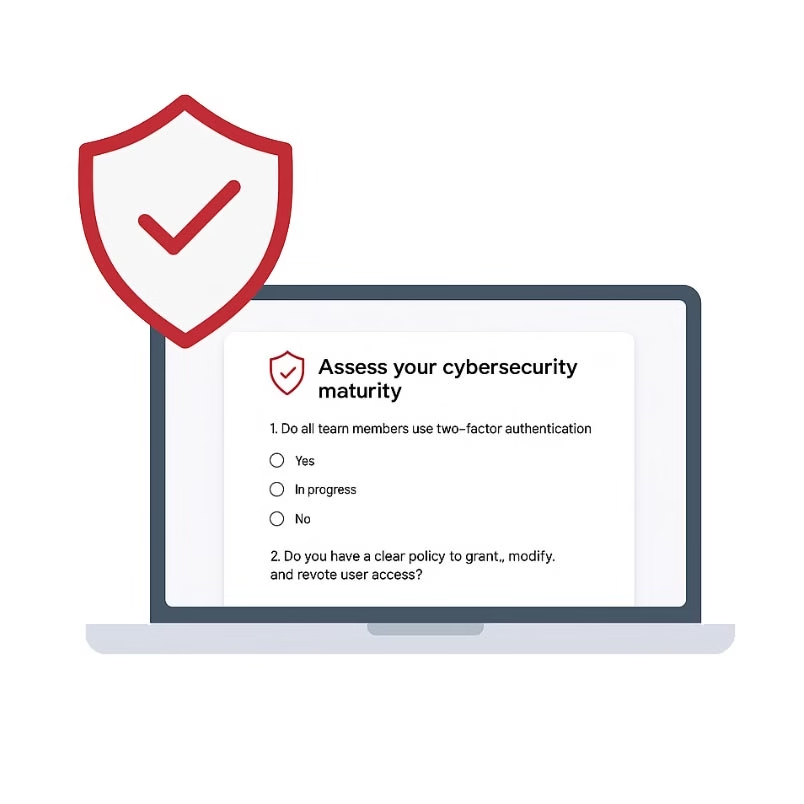
The MicroHackers Cybersecurity Maturity Assessment is a self-guided questionnaire that covers five core domains: organizational governance, technical controls, incident preparedness, data protection practices, and third-party risk management.
Each domain is scored individually, and then an overall maturity level is calculated on a scale from 1 (Initial) to 5 (Optimized). The assessment takes less than 3 minutes to complete and generates a PDF report with your scores, a visual breakdown per domain, and prioritized recommendations tailored to your results.
No registration is required. We don’t store your answers or personal information. The assessment runs entirely in your browser, and the report is generated on the spot.
How to Use This Assessment
Follow these steps to evaluate your organization’s cybersecurity maturity level:
- Start the assessment — Click the “Start Assessment” button above. No account or registration is needed.
- Answer by domain — Rate your organization across five core areas: governance, technical controls, incident preparedness, data protection, and third-party risk. Select the option that best reflects your current practices.
- Review your maturity score — After completing all domains, you will receive an overall maturity level from 1 (Initial) to 5 (Optimized), along with individual scores per domain.
- Analyze the visual breakdown — Review the radar chart and per-domain summary to identify your strongest areas and the domains that need the most improvement.
- Download your PDF report — Generate a detailed report with your scores, visual breakdown, and prioritized recommendations to share with your team or include in your compliance documentation.
Understanding the Maturity Levels
Level 1 — Initial: Security measures exist only informally. There is no documented policy, and responses to threats are ad hoc. Most organizations that have never conducted a formal assessment start here.
Level 2 — Developing: Basic security practices are in place, but they are not consistently applied. Some policies exist on paper but lack enforcement or regular review.
Level 3 — Defined: Security processes are documented, communicated, and followed across the organization. Roles and responsibilities are clear, and there is a designated person or team managing cybersecurity.
Level 4 — Managed: Security is measured and monitored. Metrics are used to track performance, incidents are handled through formal processes, and regular audits or penetration tests are part of the routine.
Level 5 — Optimized: The organization continuously improves its security posture. Threat intelligence feeds into decision-making, automation handles repetitive tasks, and security is integrated into every business process.
What Frameworks Is This Based On?
Our assessment draws from recognized industry frameworks including the NIST Cybersecurity Framework (CSF), ISO/IEC 27001, and the CIS Controls. These frameworks provide the foundation for evaluating security programs across sectors and company sizes. We’ve adapted them specifically for startups and SMEs, focusing on the controls that deliver the most impact with limited resources.
Frequently Asked Questions
Is this assessment really free?
Yes, completely free. There is no paywall, no registration, and no hidden upsells. We built this tool to help companies understand their security posture and to raise awareness about cybersecurity fundamentals.
How accurate is the assessment?
The assessment provides a reliable high-level overview based on your self-reported answers. It is not a substitute for a professional audit or penetration test, but it gives you a strong starting point to understand where you stand and what to focus on next.
Can I share the PDF report with my team or management?
Absolutely. The report is designed to be shared. Many organizations use it to present their current security posture to leadership, justify budget for security improvements, or prepare for compliance conversations.
What should I do after getting my results?
Focus on the domain with the lowest score first. The report includes specific recommendations for each area. If you want expert guidance, you can book a free consultation with our team to discuss your results and plan next steps.
How often should I retake the assessment?
We recommend retaking it every 6 to 12 months, or after any significant change in your IT infrastructure, team, or regulatory requirements. Tracking your maturity score over time helps demonstrate security progress to stakeholders.